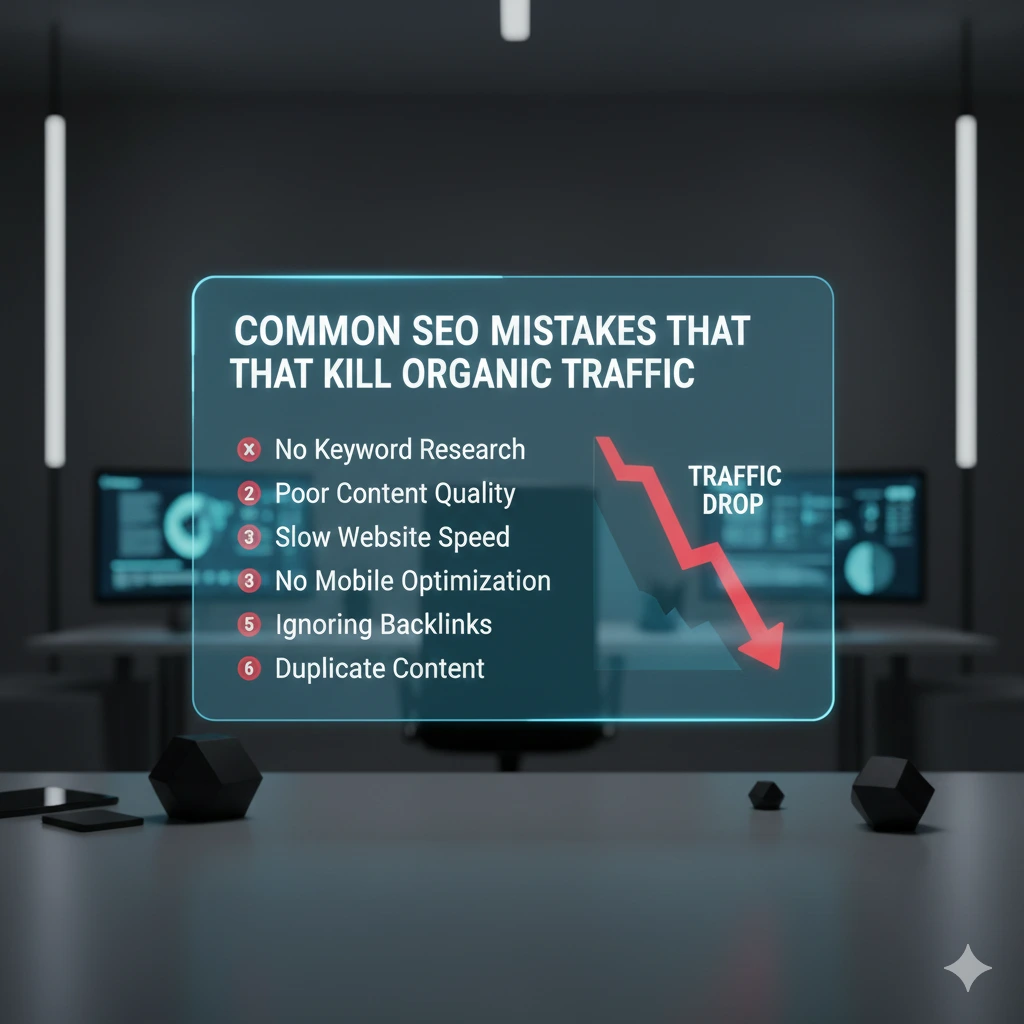
Common SEO Mistakes That Kill Organic Traffic.
Many businesses invest time, money, and effort into SEO, yet still see their organic traffic decline or stagnate. In most cases, the problem is not that SEO “doesn’t work,” but that critical mistakes are silently killing performance. These mistakes often go unnoticed because they accumulate slowly, damaging rankings, visibility, and conversions over time.
In this article, we’ll break down the most common SEO mistakes that destroy organic traffic, explain why they are harmful, and show how to avoid them in a modern search environment.
1. Ignoring Search Intent
One of the most damaging SEO mistakes is targeting keywords without understanding search intent.
Search intent answers one question: What does the user actually want?
There are four main types:
- Informational.
- Navigational.
- Commercial.
- Transactional.
Many websites target high-volume keywords but publish content that does not match the intent behind the search. When users bounce quickly, Google interprets that as poor relevance.
Why This Kills Traffic.
- Low engagement.
- High bounce rates.
- Poor ranking retention.
How to Fix It.
Analyze the top-ranking pages for your target keyword and align your content format, depth, and purpose accordingly.
2. Publishing Thin or Low-Value Content.
Content created only to “fill space” or hit a word count no longer works. Pages that provide little value, repeat generic information, or are clearly written for search engines rather than users will struggle to rank.
In 2026, quality is no longer optional.
Why This Kills Traffic.
- Google filters out low-value pages.
- Pages fail to attract backlinks.
- Users do not engage or return.
How to Fix It.
Create content that:
- Solves a real problem.
- Includes original insights.
- Demonstrates real experience.
- Is clearly better than competing pages.
3. Overusing AI Without Human Editing.
AI tools are widely used in content creation, but relying on them without human oversight leads to generic, repetitive, and untrustworthy pages.
Google does not penalize AI directly, but it rewards usefulness and authenticity—something AI alone struggles to deliver.
Why This Kills Traffic.
- Content lacks originality.
- Pages sound the same as competitors.
- Weak expertise signals.
How to Fix It.
Use AI for structure and efficiency, but always add:
- Human expertise.
- Real examples.
- Industry-specific context.
- Clear opinions.
4. Neglecting Technical SEO Basics.
Many sites lose traffic simply because Google cannot crawl or index them properly.
Common technical mistakes include:
- Broken internal links.
- Incorrect canonical tags.
- Noindex errors.
- Duplicate content issues.
- Poor mobile usability.
Why This Kills Traffic.
- Pages disappear from search results.
- Rankings drop unexpectedly.
- Crawl budget is wasted.
How to Fix It.
Run regular technical audits and fix issues quickly. Technical SEO is the foundation—without it, content cannot perform.
5. Poor Website Speed and User Experience.
User experience is a ranking factor. Slow-loading pages, cluttered layouts, and confusing navigation drive users away.
Google measures how users interact with your site, especially on mobile devices.
Why This Kills Traffic.
- Higher bounce rates.
- Lower engagement signals.
- Reduced conversions.
How to Fix It.
- Optimize images.
- Improve server response time.
- Simplify design.
- Ensure mobile-first usability.
6. Keyword Stuffing and Over-Optimization.
Some websites still try to force keywords unnaturally into content, headings, and meta tags. This outdated tactic does more harm than good.
Modern SEO focuses on topic relevance, not repetition.
Why This Kills Traffic.
- Content becomes unreadable.
- Google detects manipulation.
- Rankings stagnate or decline.
How to Fix It.
Write naturally and focus on covering the topic comprehensively. Use synonyms and related terms instead of repeating the same keyword.
7. Ignoring Internal Linking Strategy.
Internal links help search engines understand:
- Page relationships.
- Content hierarchy.
- Topic authority.
Many sites either ignore internal linking or do it randomly.
Why This Kills Traffic.
- Important pages lack authority.
- Content becomes isolated.
- Crawl efficiency decreases.
How to Fix It.
Create logical internal links that guide users and search engines to your most important pages.
8. Not Optimizing for Mobile Users.
Mobile-first indexing means Google primarily evaluates the mobile version of your site. If your mobile experience is poor, rankings will suffer.
Why This Kills Traffic.
- Mobile users abandon slow or broken pages.
- Rankings drop across all devices.
- Conversions decline.
How to Fix It.
Test your site on real mobile devices and prioritize speed, readability, and usability.
9. Ignoring Google Business Profile (Local SEO).
For local businesses, failing to optimize Google Business Profile is one of the biggest missed opportunities.
Many businesses rely only on their website and ignore Maps visibility.
Why This Kills Traffic.
- Lost local visibility.
- Fewer calls and visits.
- Competitors dominate Maps results.
How to Fix It.
Optimize:
- Business categories.
- Descriptions.
- Photos.
- Reviews
- Regular updates.
10. Inconsistent Content Publishing.
SEO rewards consistency. Publishing sporadically or abandoning content creation entirely slows growth and weakens authority.
Why This Kills Traffic.
- Loss of topical relevance.
- Reduced crawl frequency.
- Slower ranking improvements.
How to Fix It.
Create a realistic publishing schedule and stick to it. Quality matters more than frequency, but consistency matters.
11. Not Updating Old Content.
SEO is not “set it and forget it.” Outdated content loses rankings over time, especially in competitive industries.
Why This Kills Traffic.
- Information becomes inaccurate.
- Competitors publish fresher content.
- Rankings gradually drop.
How to Fix It.
Regularly update:
- Statistics.
- Examples.
- Formatting.
- Internal links.
Refreshing content often restores lost traffic faster than creating new pages.
12. Chasing Traffic Instead of Conversions.
High traffic numbers mean nothing if visitors do not convert. Many websites focus only on rankings and forget business goals.
Why This Kills Traffic.
- Poor engagement signals.
- Low dwell time.
- Missed ROI opportunities.
How to Fix It.
Optimize content for:
- Clear calls to action.
- User journey.
- Trust signals.
- Conversion paths.
SEO should support business growth, not vanity metrics.
13. Building Low-Quality Backlinks.
Backlinks still matter, but poor-quality links can hurt rankings. Automated link building, spammy directories, and irrelevant links create risk.
Why This Kills Traffic.
- Algorithmic suppression.
- Loss of trust.
- Ranking instability.
How to Fix It.
Focus on:
- Relevance.
- Authority.
- Natural link acquisition.
- Content worth linking to.
14. Ignoring Analytics and Data.
Many businesses do SEO blindly without tracking performance properly.
Why This Kills Traffic.
- Problems go unnoticed.
- Opportunities are missed.
- Decisions are based on assumptions.
How to Fix It.
Track:
- Organic traffic trends.
- Keyword movement.
- Conversion data.
- User behavior.
SEO decisions should be data-driven.
15. Expecting Instant Results.
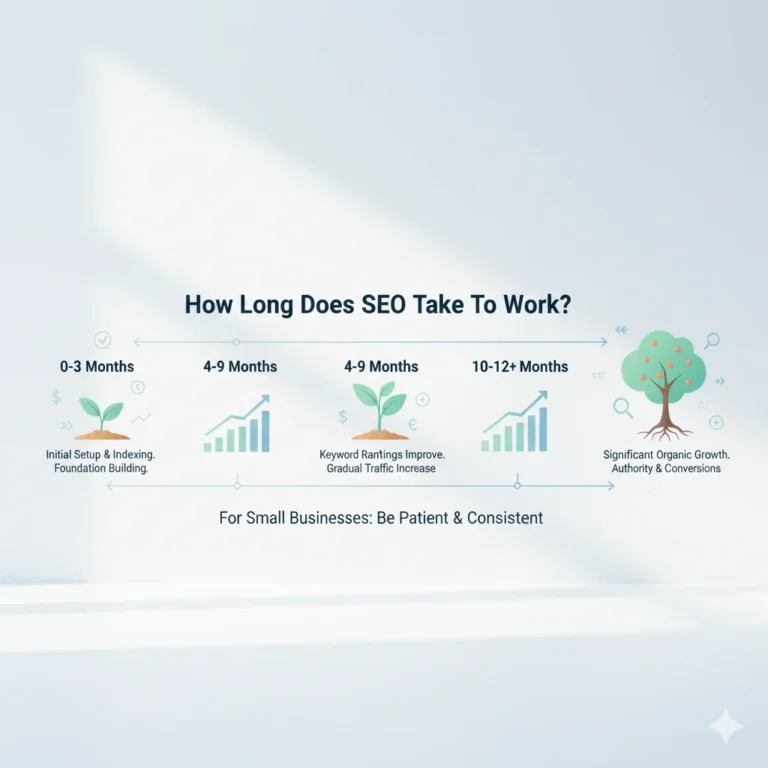
SEO takes time. One of the most common reasons businesses quit too early is unrealistic expectations.
Why This Kills Traffic.
- SEO efforts stop before results appear.
- Momentum is lost.
- Competitors overtake rankings.
How to Fix It.
Commit to SEO as a long-term strategy, typically 6–12 months for meaningful results.
Final Thoughts: Avoiding SEO Mistakes Is Half the Battle.
Most organic traffic losses are not caused by algorithm updates alone. They are caused by avoidable mistakes, poor execution, and outdated thinking.
SEO in 2026 rewards:
- Quality over quantity.
- User experience over tricks.
- Strategy over shortcuts.
- Consistency over intensity.
By identifying and fixing these common SEO mistakes, businesses can not only recover lost traffic but build a stronger, more sustainable organic presence.