How Long Does SEO Take to Work for Small Businesses?.
One of the most common questions small business owners ask before investing in SEO is simple but critical: How long does SEO actually take to work? Unlike paid advertising, search engine optimization is not instant. It is a long-term strategy that builds visibility, authority, and consistent traffic over time.
Understanding realistic SEO timelines helps small businesses set proper expectations, avoid common mistakes, and make smarter marketing decisions. This article explains how long SEO usually takes to work for small businesses, what factors influence the timeline, what results look like at each stage, and how to accelerate progress without risking penalties.
The Short Answer: SEO Is Not Instant, but It Is Sustainable.
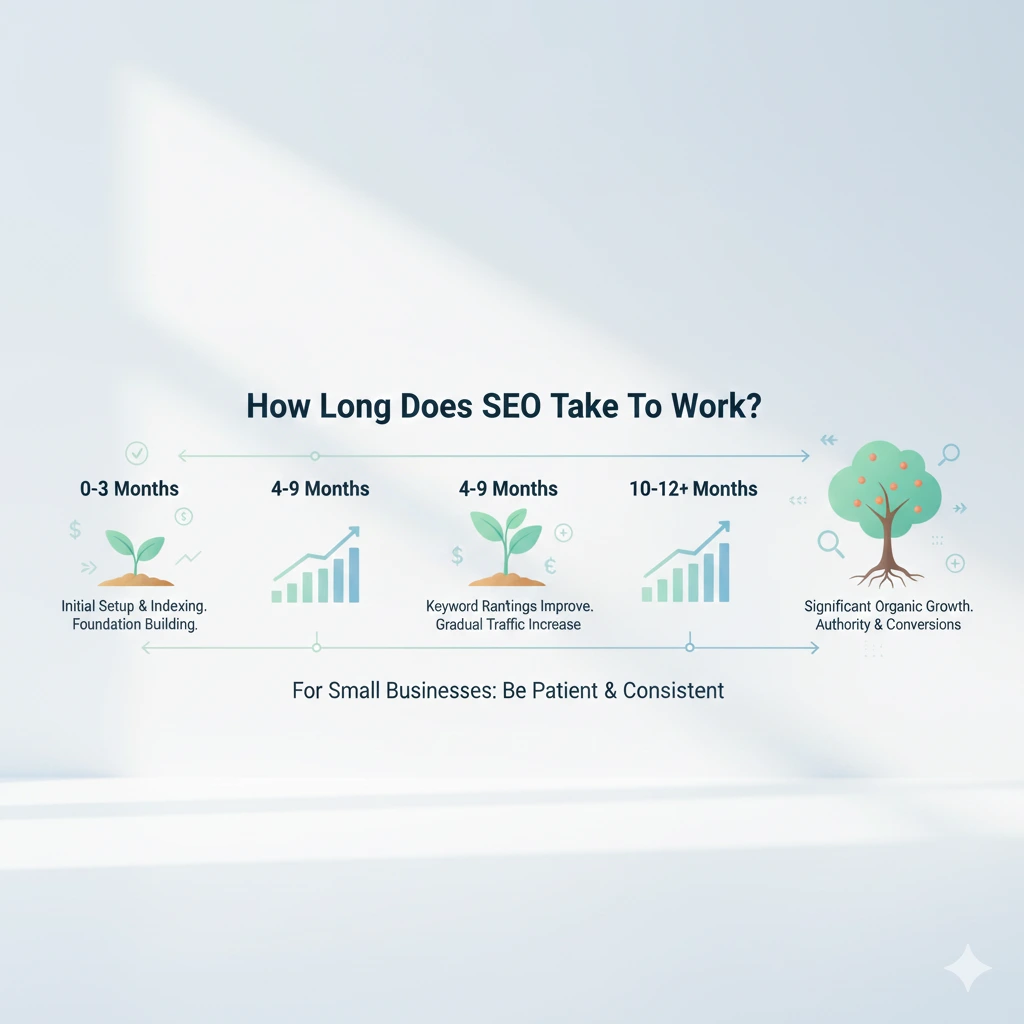
For most small businesses, SEO typically starts showing initial results within 3 to 6 months, with strong and consistent results appearing between 6 and 12 months. In competitive industries or markets, meaningful results can take 12 months or more.
However, these timelines are not fixed. SEO results depend heavily on factors such as competition, website quality, content strategy, and consistency.
The key difference between SEO and other marketing channels is that SEO compounds over time. What you build today continues working months and even years later.
Why SEO Takes Time.
SEO takes time because search engines need to trust your website. Google does not rank new or poorly optimized websites quickly, especially for competitive keywords.
Here are the main reasons SEO is a gradual process:
- Search engines need time to crawl and index changes.
- Rankings are influenced by authority and trust signals.
- Content needs time to earn visibility and engagement.
- Competitors are also optimizing continuously.
SEO is not a switch you turn on; it is a system you build.
Typical SEO Timeline for Small Businesses.
While every project is different, most SEO campaigns follow a predictable pattern.
Month 1: Research, Setup, and Fixes
The first month is usually focused on foundations rather than rankings.
Common activities include:
- Technical SEO audit.
- Keyword research.
- Competitor analysis.
- Fixing site structure, speed, and indexing issues.
- Optimizing existing pages.
At this stage, rankings usually do not change significantly, but this work is critical for everything that follows.
Months 2–3: Early Signals and Initial Movement.
During months two and three, search engines begin to recognize improvements.
What may happen:
- Pages get indexed more efficiently.
- Low-competition keywords start ranking.
- Small increases in impressions and clicks.
- Better crawlability and site health.
Traffic growth is usually modest, but this is when SEO starts “working behind the scenes.”
Months 4–6: Visible Results Begin.
For many small businesses, this is when SEO becomes noticeable.
Typical outcomes include:
- Ranking for long-tail and informational keywords.
- Increased organic traffic.
- More engagement from search visitors.
- First leads or inquiries from SEO.
Businesses in low to medium competition niches often see meaningful results in this phase.
Months 6–12: Growth and Stability.
Between six and twelve months, SEO begins to show its real value.
Results may include:
- Rankings for competitive keywords.
- Consistent monthly traffic growth.
- Lower reliance on paid advertising.
- Predictable lead generation.
This is when SEO shifts from an experiment to a core business channel.
After 12 Months: Compounding Returns.
Well-executed SEO continues to grow over time.
Long-term benefits include:
- Strong domain authority.
- Easier ranking for new content.
- Stable traffic even during ad budget cuts.
- Higher conversion rates from trust and visibility.
At this stage, SEO becomes a long-term asset rather than a cost.
Factors That Affect How Fast SEO Works.
Not all small businesses see results at the same speed. Several factors influence SEO timelines.
Website Age and History.
Older websites with a clean history often rank faster than brand-new domains. New sites usually take longer because search engines have no trust signals yet.
Competition Level.
Ranking for “plumber in a small town” is much faster than ranking for “SEO services” in a major city. The more competitors investing in SEO, the longer it takes.
Industry and Search Intent.
Some industries naturally perform better in SEO:
- Local services.
- Professional services.
- Niche expertise websites.
Highly saturated industries may require more time and resources.
Content Quality and Strategy.
SEO works faster when content:
- Matches real search intent.
- Answers questions clearly.
- Is well-structured and in-depth.
- Is published consistently.
Thin or generic content slows everything down.
Technical SEO and Site Performance.
Slow websites, poor mobile usability, or indexing issues can delay results significantly, even with good content.
Consistency of Effort.
SEO rewards consistency. Businesses that publish content regularly and optimize continuously see faster and more stable results.
Local SEO vs Traditional SEO Timelines.
Local SEO often works faster than national or global SEO.
Local SEO.
- Initial results: 1–3 months.
- Strong visibility: 3–6 months.
- Focus: Google Maps, reviews, local pages.
Traditional / National SEO.
- Initial results: 3–6 months.
- Strong visibility: 6–12 months.
- Focus: content, authority, backlinks.
For small businesses serving specific locations, local SEO can deliver quicker wins.
Common SEO Myths That Slow Results.
Many small businesses delay SEO success by believing myths.
“SEO Should Work in 30 Days”.
SEO is not paid advertising. Quick results often come from risky tactics that lead to penalties.
“More Keywords Means Faster Results”.
Targeting too many keywords at once dilutes focus. Strategic targeting works better.
“SEO Is Just Content”.
Content matters, but without technical optimization and authority building, content alone is not enough.
“Once You Rank, You’re Done”.
SEO requires maintenance. Competitors and algorithms change constantly.
How Small Businesses Can Speed Up SEO (Safely).
While SEO cannot be rushed irresponsibly, there are ways to accelerate results without risk.
Focus on Long-Tail Keywords.
Long-tail keywords are less competitive and bring faster wins.
Fix Technical Issues Early.
A technically sound website allows search engines to rank content faster.
Publish High-Intent Content.
Answer real questions potential customers are already searching for.
Optimize Existing Pages.
Improving current content often delivers faster results than creating new pages.
Build Internal Linking.
Strong internal links help search engines understand content importance.
Combine SEO With Local Optimization.
Google Business Profile optimization often produces quicker visibility.
SEO vs Paid Ads: Timeline Comparison.
Understanding SEO timelines is easier when compared to paid ads.
| Aspect | SEO | Paid Ads |
|---|---|---|
| Speed | Slow at first | Immediate |
| Cost over time | Decreases | Increases |
| Long-term value | High | Stops when budget stops |
| Trust factor | High | Medium |
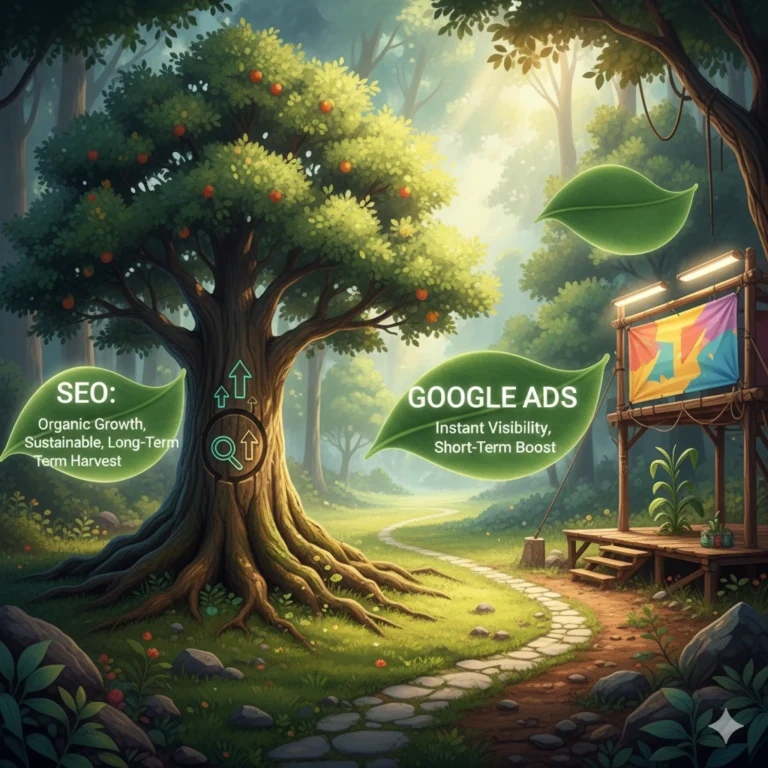
Many small businesses use paid ads short-term while SEO builds long-term stability.
Is SEO Worth the Wait for Small Businesses?.
For most small businesses, the answer is yes.
SEO:
- Reduces long-term marketing costs.
- Brings consistent, high-intent traffic.
- Builds credibility and trust.
- Supports every other marketing channel.
Businesses that quit SEO too early often miss the most profitable phase.
Signs That SEO Is Working (Even Before Traffic Explodes).
SEO success is not only about traffic spikes.
Early positive signals include:
- Increased impressions in Google Search Console.
- Improved keyword rankings.
- Better engagement metrics.
- More branded searches.
- Higher conversion quality.
Recognizing these signals prevents premature abandonment of SEO efforts.
When Should a Small Business Hire SEO Services?.
Hiring SEO professionals is often beneficial when:
- You lack time or technical knowledge.
- Your website is not ranking after months of effort.
- You are in a competitive market.
- You want faster, more predictable results.
Professional SEO helps avoid costly mistakes and accelerates growth.
Final Thoughts.
So, how long does SEO take to work for small businesses? In most cases, 3 to 6 months for early results, 6 to 12 months for strong growth, and ongoing benefits beyond that. SEO is not about instant gratification but about building a durable digital asset.
Small businesses that understand SEO timelines, stay consistent, and focus on quality are the ones that benefit the most. Those who treat SEO as a long-term investment often outperform competitors who rely only on short-term tactics.